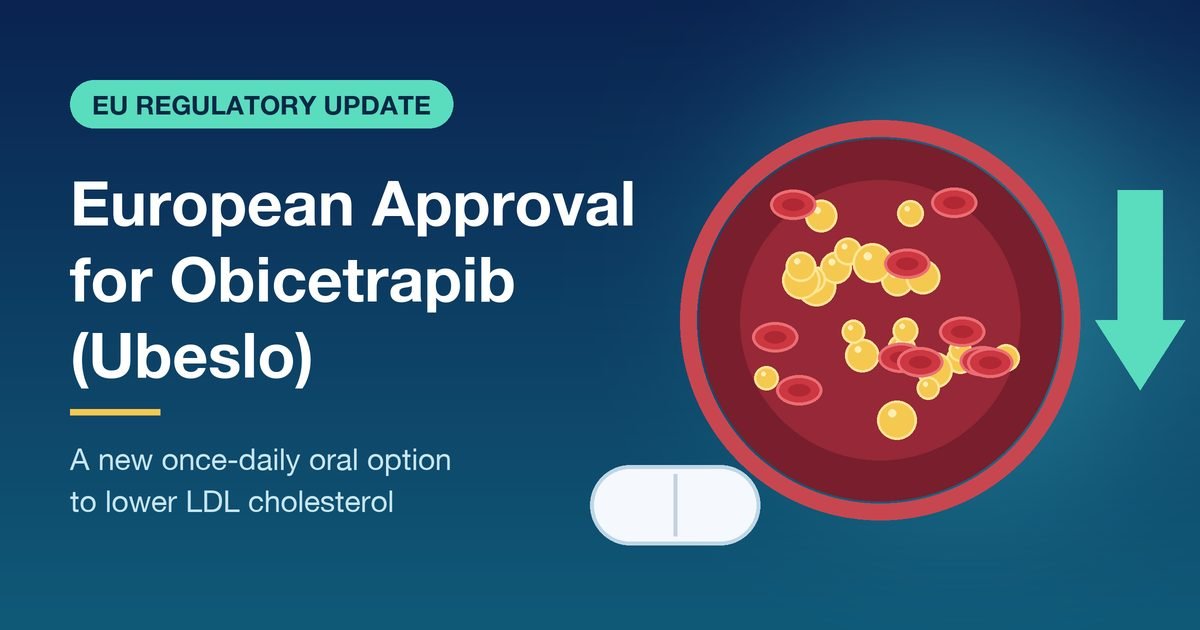
European Commission Approves Obicetrapib (Ubeslo), the First Approval for This Oral CETP Inhibitor
Cardiovascular Health | EU Regulatory Update
Cholesterol care in Europe has a new option. On 21 September 2026, NewAmsterdam Pharma and the Menarini Group announced that the European Commission had granted marketing authorisation for Ubeslo (obicetrapib 10 mg), a once-daily tablet that lowers LDL cholesterol by blocking a blood protein called CETP. The same decision also cleared Evlarco, a fixed-dose tablet that pairs obicetrapib 10 mg with ezetimibe 10 mg.
This is the first regulatory approval for the medicine anywhere in the world. Menarini holds the European commercial rights and will handle the rollout across the EU.
Key facts at a glance
Active substance: obicetrapib (CETP inhibitor, ATC C10AX22)
Products: Ubeslo (monotherapy) and Evlarco (with ezetimibe)
Form: 10 mg film-coated tablet, taken once daily by mouth
CHMP positive opinion: 23 July 2026; EC approval announced 21 September 2026
Most common side effects: high blood pressure, dizziness, headache, diarrhoea, abdominal pain
Who Can Receive This Treatment?
According to the European Medicines Agency product summary, the medicine is approved for adults with primary hypercholesterolaemia (both heterozygous familial and non-familial forms) or mixed dyslipidaemia. It is used alongside a cholesterol-lowering diet in two situations:
together with a statin, with or without other lipid-lowering drugs, when LDL-C goals are not reached on the highest statin dose a patient can tolerate; or
alone or with other lipid-lowering drugs when a patient cannot tolerate statins, or statins are not suitable for them.
In other words, it is not meant to replace statins for most people. It is an add-on for patients whose "bad" cholesterol stays too high despite standard care.
How Does Obicetrapib Work?
Cholesteryl ester transfer protein (CETP) moves cholesterol between particles in the blood. When CETP is blocked, less cholesterol is shifted into LDL particles, and LDL-C levels fall. HDL ("good") cholesterol tends to rise at the same time, although the regulatory case rests on the LDL-lowering effect.
What the Phase 3 Trials Showed
The approval draws on three Phase 3 studies. The EMA notes that the benefit was seen in two 52-week, randomised, double-blind, placebo-controlled studies in adults already on maximum tolerated lipid-lowering therapy.
BROADWAY
Enrolled patients at high cardiovascular risk and showed significant LDL-C reductions versus placebo on top of existing therapy.
BROOKLYN
Studied adults with heterozygous familial hypercholesterolaemia (HeFH), an inherited condition that drives very high LDL-C from a young age. Here too, LDL-C fell substantially compared with placebo.
TANDEM
Tested the fixed-dose combination with ezetimibe, the basis for Evlarco.
up to 40%
LDL-C reduction vs placebo with obicetrapib alone
about 50%
LDL-C reduction vs placebo with the ezetimibe combination
CETP inhibition has a difficult history. Torcetrapib was stopped over safety concerns, dalcetrapib and evacetrapib failed to show meaningful cardiovascular benefit, and anacetrapib, despite a modest effect, was never brought to market. For almost two decades, the idea looked like a dead end.
Obicetrapib is the first drug in this class to clear a major regulator. Its once-daily oral dosing, and the option of a single combined tablet with ezetimibe, may help patients who remain above their LDL-C targets despite current treatment.
The bigger question is still open. The PREVAIL Phase 3 outcomes trial, which randomised more than 9,500 patients, is testing whether the drug reduces heart attacks, strokes and other major cardiovascular events, not just cholesterol numbers.
Safety and Regulatory Notes
Because it is a new active substance in the EU, the medicine is under additional monitoring. Patients using a product supplied through us can log a suspected side effect with our safety team. The EMA lists high blood pressure (hypertension), dizziness, headache, diarrhoea and abdominal pain as the most common side effects.
Detailed prescribing guidance, including warnings and interactions, will be set out in the SmPC published on the EMA website.
Access Outside the European Union
A new approval in one region often means patients elsewhere must wait months or years for local registration, because approval timelines differ widely from one country to the next. In the meantime, some countries allow a doctor to request a medicine for an individual patient on a named patient or compassionate-use basis. Our guide to how early access programmes work explains the basics for patients and families.
Ikris Pharma Network works with physicians, hospitals and distributors on regulated, prescription-led sourcing of specialty medicines. Availability of any newly approved product depends on the manufacturer's launch plans and the rules of the destination country, so each request is assessed case by case. A typical request starts with a prescription from the treating doctor, a short clinical justification and, where the destination country requires it, an import permit from the local health authority.
Have a question about sourcing a new lipid-lowering therapy?
Doctors and procurement teams can learn about our named patient services, call +91-9654860915 / 18001200365, or email info@ikrispharmanetwork.com.
Sources
European Medicines Agency. Ubeslo: CHMP summary of opinion and product details (EMEA/H/C/006516), July 2026.
Menarini Group and NewAmsterdam Pharma. European Commission approval announcement for Ubeslo and Evlarco, PR Newswire, 21 September 2026.
Medical Disclaimer
This article is for general information only and is not medical advice, treatment guidance or a recommendation to use any medicine. Prescribing decisions should be based on the approved product information and each patient's clinical situation.