



Ustekinumab (Stelara) for Psoriasis, Psoriatic Arthritis, Crohn Disease & Ulcerative Colitis: India Supply
Ustekinumab (Stelara) for Plaque Psoriasis, Psoriatic Arthritis, Crohn Disease and Ulcerative Colitis: A Plain-English Guide
Medically Reviewed By: Shilpi Banerjee, Registered Pharmacist (M.Pharm)
Last updated: September 2026
Living with a condition where the immune system attacks the body's own tissue — skin, joints, or the gut — usually means trying several treatments before finding one that holds. This medicine is a biologic that has been used for that purpose across four quite different conditions: moderate to severe plaque psoriasis, active psoriatic arthritis, and moderately to severely active Crohn disease and ulcerative colitis.
This guide covers how it works, what the FDA-reviewed trials actually showed for each condition, how it is dosed, and what to watch for. Every figure below comes directly from the current FDA-approved prescribing information, not from marketing material or secondhand summaries. Approvals and label wording change over time and differ by country, so treat this as background reading, not a substitute for what your own physician tells you.
At a Glance
| Drug class | IL-12 and IL-23 antagonist — a biologic, not a small-molecule pill |
| Brand name | Stelara (ustekinumab), Janssen Biotech |
| Used for | Moderate to severe plaque psoriasis, active psoriatic arthritis, and moderately to severely active Crohn disease and ulcerative colitis |
| Who can use it | Adults for all four conditions; children from age 6 for psoriasis and psoriatic arthritis, and from age 2 for Crohn disease and ulcerative colitis |
| How it is given | A subcutaneous injection under the skin for psoriasis and psoriatic arthritis; an initial IV infusion followed by subcutaneous injections for Crohn disease and ulcerative colitis |
| Before starting | Screening for tuberculosis is required, and any active infection should be treated first |
| Common side effects | Nasopharyngitis (a common cold-type infection), upper respiratory infection, headache and fatigue |
| Good to know | Not a cure — it controls symptoms and is usually continued long-term once it is working |
How Does It Work?
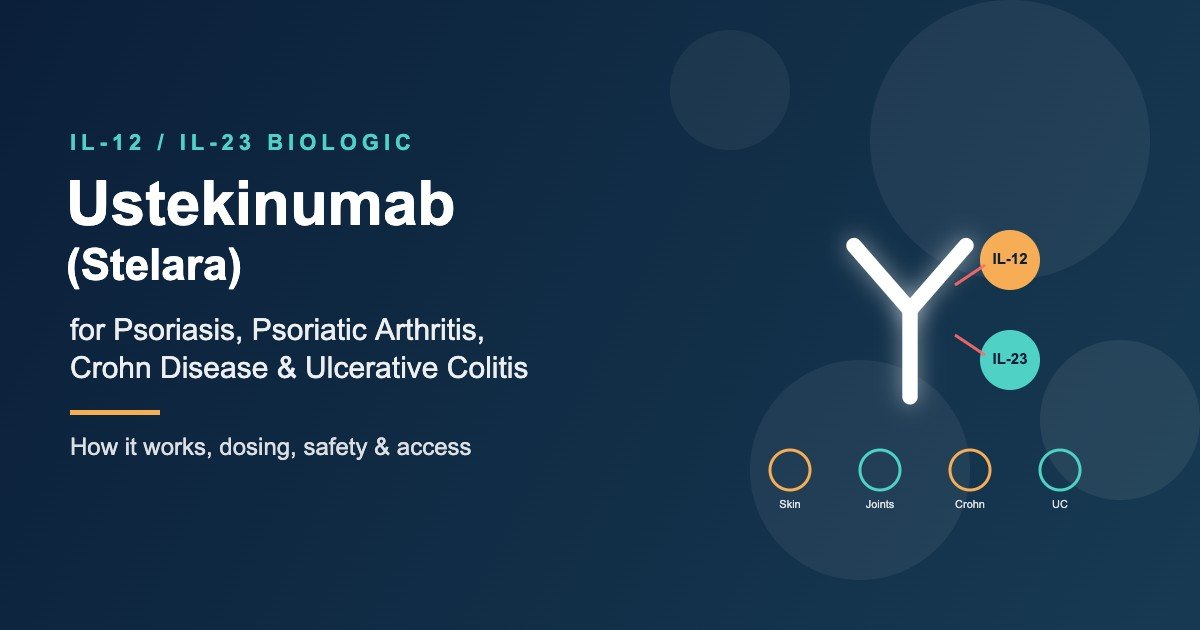
In each of these four conditions, the immune system is overactive in a specific way, driven partly by two signalling proteins called interleukin-12 (IL-12) and interleukin-23 (IL-23).
IL-12 Helps direct certain immune cells to attack, and is linked to the inflammation seen in psoriasis and psoriatic arthritis. | IL-23 Keeps a related group of immune cells active for longer than they should be, driving ongoing inflammation in the skin, joints and gut. | What this medicine does Binds to a shared piece of both proteins, so neither one can attach to its receptor and switch on that inflammatory signal. |
Because it targets a shared building block of both proteins, one medicine can calm inflammation in the skin, the joints and the digestive tract, even though those look like very different conditions on the surface.
Why Does the Injection Site or Route Change by Condition?
- For plaque psoriasis and psoriatic arthritis, every dose is a subcutaneous injection, which many patients eventually learn to give themselves at home.
- For Crohn disease and ulcerative colitis, the first dose is a weight-based intravenous infusion given in a clinic, because a larger amount is needed to bring active gut inflammation under control quickly. After that, maintenance doses switch to a subcutaneous injection.
A Practical Note on Weight-Based Dosing
For the gut conditions in particular, both the induction infusion and some pediatric maintenance doses are calculated by body weight in kilograms, not given as one fixed amount. This is normal and is handled by the treating clinic — it is not something a patient needs to calculate themselves.
Which Conditions Is This Approved For?
The table gives the current FDA-approved picture. Each condition is covered in more detail below.
| Condition | Who it is for | How it is typically started |
|---|---|---|
| Plaque psoriasis | Moderate to severe disease in adults and children 6 years and older who are candidates for phototherapy or systemic therapy | Subcutaneous injection, weight-based in children |
| Psoriatic arthritis | Active disease in adults and children 6 years and older | Subcutaneous injection |
| Crohn disease | Moderately to severely active disease in adults and children 2 years and older | Weight-based IV infusion, then subcutaneous maintenance |
| Ulcerative colitis | Moderately to severely active disease in adults and children 2 years and older | Weight-based IV infusion, then subcutaneous maintenance |
Plaque Psoriasis
This is the condition the medicine was first approved for, and it remains the most extensively studied use.
- Approved for adults and children 6 years and older with moderate to severe disease who are candidates for phototherapy or systemic treatment.
- Effect is usually judged using PASI 75, meaning at least a 75% reduction in a standard psoriasis severity score.
| 66–76% vs 3–4% | Ps STUDY 1 / PHOENIX 1 · NCT00267969 and Ps STUDY 2 / PHOENIX 2 · NCT00307437 Proportion of adults reaching PASI 75 at week 12, on the approved dose vs placebo, across the two pivotal trials (n=1,996 combined). Clearance was largely maintained through week 40, and continued dosing held the response better than stopping treatment. |
Staying on Treatment vs Stopping
In one of the pivotal trials, patients who kept taking their scheduled doses stayed clear far more often at one year (89%) than those who had treatment withdrawn after an initial response (63%). Among those withdrawn, the improvement typically faded within about 16 weeks — a useful thing to know if a break in treatment is ever being considered.
Psoriatic Arthritis
Approved for adults and children 6 years and older with active disease, including in people who already have joint damage.
| 42–50% vs 20–23% | PsA STUDY 1 / PSUMMIT 1 · NCT01009086 and PsA STUDY 2 / PSUMMIT 2 · NCT01077362 Proportion of adults reaching an ACR 20 response (a standard 20% improvement in joint symptoms) at week 24, on the approved dose vs placebo, across two trials totaling 927 patients. Response was similar whether or not patients were also taking methotrexate, and regardless of prior biologic treatment. |
Beyond joint counts, the trials also measured pain, physical function and inflammation markers (CRP), and each moved further in the treated groups than with placebo. Improvement in enthesitis (inflammation where tendons attach to bone) and dactylitis (swollen "sausage" fingers or toes) was also observed.
Crohn Disease
Approved as a two-part regimen: an intravenous starting dose to bring active disease under control, followed by ongoing subcutaneous injections to maintain that response.
Getting Disease Under Control (Induction)
| Up to 40% remission | CD-1 / UNITI-1 · NCT01369329 and CD-2 / UNITI-2 · NCT01369342 Proportion of adults in clinical remission (a standard symptom score under 150) at week 8 on the approved IV induction dose, compared with 7–20% on placebo, across two trials (combined n=1,368). One trial enrolled patients who had already failed a TNF-blocker biologic; the other enrolled patients newer to biologic treatment, which is part of why the two placebo-adjusted results differ. |
Staying in Remission (Maintenance)
| 53% vs 36% | CD-3 / IM-UNITI · NCT01369355 Proportion of patients in clinical remission at week 44 (52 weeks total) on the approved subcutaneous maintenance dose vs placebo, among 259 patients who had responded to the induction dose. 47% of treated patients were both corticosteroid-free and in remission at that point, vs 30% on placebo. |
Ulcerative Colitis
Approved on the same induction-then-maintenance pattern as Crohn disease, for adults and children with moderately to severely active disease who have not responded well enough to other treatments.
Getting Disease Under Control (Induction)
| 19% vs 7% | UC-1 / UNIFI induction · NCT02407236 Proportion of adults in clinical remission at week 8 on the approved IV induction dose vs placebo, among 641 patients (measured on the Mayo score, a standard colitis severity scale). A larger share also showed endoscopic improvement on colonoscopy: 25% vs 13%. |
Staying in Remission (Maintenance)
| 45% vs 26% | UC-2 / UNIFI maintenance · NCT02407236 Proportion of patients in clinical remission at week 44 (52 weeks total) on the approved subcutaneous maintenance dose vs placebo, among 351 patients who had responded to induction. Endoscopic improvement was also more common on treatment: 47% vs 27%. |
How Is It Given?
The dose and route depend entirely on which condition is being treated and, for children, on body weight. The table below gives the general shape of each regimen; the exact numbers for a specific patient are set by the prescribing clinician.
| Condition | Starting dose | Ongoing dose |
|---|---|---|
| Plaque psoriasis (adult) | 45 mg subcutaneously (90 mg if body weight is over 100 kg), then again 4 weeks later | Same dose every 12 weeks |
| Psoriatic arthritis (adult) | 45 mg subcutaneously (90 mg if over 100 kg with psoriasis), then again 4 weeks later | Same dose every 12 weeks |
| Crohn disease / ulcerative colitis (adult) | One weight-based intravenous infusion (260, 390 or 520 mg depending on body weight) | 90 mg subcutaneously 8 weeks later, then every 8 weeks |
What Matters for a Patient
- Subcutaneous doses can often be self-injected at home after training from a nurse or pharmacist.
- The intravenous starting dose for gut conditions is given at a clinic or infusion center, not at home.
- Missed subcutaneous doses are generally given as soon as remembered, then the regular schedule resumes — but check with the prescribing clinic rather than guessing.
Side Effects and Safety
Infections: The Main Safety Concern
Because this medicine dampens part of the immune system, it can make some infections more likely or let a dormant one reactivate. This is the central safety theme across all four approved uses.
- Screening for tuberculosis (TB) is required before the first dose, and any latent TB should be treated first.
- Treatment should not begin during any clinically important active infection, and is usually paused if a serious infection develops.
- Serious infections reported in trials have included pneumonia, cellulitis, abscesses, gastroenteritis and, less commonly, more unusual infections such as listeriosis.
- Live vaccines should be avoided while on treatment — tell every doctor involved in your care that you are taking this medicine before any vaccination.
- Malignancy: a possible increased risk of cancer has not been ruled out; the medicine has not been well studied in people with a personal history of cancer.
- Serious allergic reactions: can occur and require immediate discontinuation and treatment.
- Posterior reversible encephalopathy syndrome (PRES): a rare brain condition causing symptoms like headache, seizures, confusion or vision changes has been reported; it requires prompt discontinuation if suspected.
- Non-infectious lung inflammation: rare cases of certain types of pneumonia not caused by infection have been reported after the medicine reached the market.
- Genetic IL-12/IL-23 deficiency: a small number of people are born with this deficiency and are unusually vulnerable to certain infections (including from BCG vaccination) — this is a theoretical concern the label flags for that specific group.
Common Side Effects
Reported in at least 3% of patients, and usually mild:
- Nasopharyngitis (a common-cold type infection of the nose and throat) and upper respiratory tract infections
- Headache and fatigue
- Injection site redness, for subcutaneous doses
- Vomiting, more often seen during the induction infusion for gut conditions
- Diarrhea, abdominal pain and nausea, more often reported during ongoing treatment for the gut conditions
Pregnancy and Breastfeeding
- Data collected through a pregnancy registry and published literature have not identified a clear pattern of birth defects, but the overall data remain limited — discuss the specific risks and benefits with your physician if pregnancy is being planned.
- The medicine is known to cross into breast milk in small amounts; there is no evidence of harm to a breastfed infant so far, but the data are limited here too.
To report a suspected side effect involving a product we supplied, use our adverse event reporting page. You can also report directly to your national regulator or to the marketing authorization holder.
Getting This Treatment: Access, Supply and India
Why Access Can Be Hard
This is a prescription-only biologic that needs cold-chain storage and, for two of its four uses, an infusion visit to start treatment. Where it is registered and reimbursed, that pathway is usually already set up through a specialty pharmacy. In many other countries, it may not be launched yet, may only cover some of its approved uses, or the cost may be difficult for a family to manage without support.
How Ikris Pharma Network Can Help
Ikris Pharma Network is a pharmaceutical sourcing and supply company — we do not manufacture medicines. We help hospitals, pharmacies, importers and treating doctors reach hard-to-find biologic products through documented, regulated channels. Depending on the destination country, that can mean:
- Our Indian Generic Medicines service
- Our Named Patient Management service, for medicines not yet registered locally
- Guidance on the import route: read how named-patient imports work
- Other specialty medicines: see our wholesale and bulk supply guide
Whether a particular brand or biosimilar can be supplied, and for which condition, depends on the destination country's rules, the patient's prescription and current availability. We confirm each case individually and never guess.
What to Have Ready When You Contact Us
- A prescription or letter from the treating specialist, naming the condition being treated
- Recent TB screening results, if available, since this is required before starting
- The destination country and any import license or permit your hospital or pharmacy holds
- The strength, formulation and quantity needed, and the delivery address
A Word of Caution About Unverified Sellers
- Counterfeit and diverted biologics do circulate online, and a price that looks too good to be true usually is.
- This is a cold-chain product; buy only from suppliers who can document unbroken storage and transport.
- Be wary of anyone selling a prescription biologic without asking for a prescription first.
- Our trusted wholesale supplier guide explains what to look for.
Frequently Asked Questions
What is this medicine used for?
It is approved for moderate to severe plaque psoriasis, active psoriatic arthritis, and moderately to severely active Crohn disease and ulcerative colitis, in adults and, for some uses, children.
Is this a biologic or a regular tablet?
It is a biologic — a lab-grown antibody given by injection or infusion, not a tablet or capsule. It works by blocking two immune-signalling proteins (IL-12 and IL-23) rather than being absorbed and processed like a small-molecule pill.
Is it a steroid?
No. It does not work like a corticosteroid. It targets a specific part of the immune system's signalling rather than broadly suppressing inflammation the way steroids do, which is part of why many patients can eventually reduce or stop steroid use once it takes effect.
How long does it take to work?
Timelines vary by condition. In the psoriasis trials, meaningful skin clearance was assessed at week 12. In the gut conditions, clinical remission was assessed at week 8 after the starting infusion, with a further maintenance phase measured through week 44.
Does it cure the underlying condition?
No. None of the four approvals describe it as a cure. It controls inflammation and symptoms, and treatment is typically continued long-term once it is working, similar to other biologics used for these conditions.
What is the biggest safety concern?
An increased risk of infections, including reactivation of latent tuberculosis, which is why TB screening is required before starting. Serious infections, allergic reactions, and rare complications such as PRES (a reversible brain condition) are also on the label.
Can children receive this treatment?
Yes, for specific uses: from age 6 for plaque psoriasis and psoriatic arthritis, and from age 2 for Crohn disease and ulcerative colitis, with weight-based dosing in younger or smaller children.
Why does the injection method differ between conditions?
For psoriasis and psoriatic arthritis, every dose is a subcutaneous injection. For Crohn disease and ulcerative colitis, the first dose is a larger, weight-based intravenous infusion given in a clinical setting to bring active gut inflammation under control quickly, followed by subcutaneous maintenance doses.
Can I take this together with other medicines for the same condition?
Sometimes. In the psoriatic arthritis and Crohn disease trials, many patients continued methotrexate, corticosteroids or other background therapy alongside it. Any combination should be decided by the treating specialist, not adjusted independently.
What if I miss a dose?
Contact the prescribing clinic rather than guessing. General practice for a missed subcutaneous dose is to give it as soon as remembered and then resume the regular schedule, but the exact instructions depend on which condition is being treated and how much time has passed.
Is it safe during pregnancy or breastfeeding?
Data are limited for both. Pregnancy registry data collected so far have not shown a clear pattern of harm, and the medicine is known to pass into breast milk in small amounts without confirmed harm to a nursing infant, but these areas are not fully studied — discuss your specific situation with your physician.
Can this be sourced from India for patients in other countries?
Often, yes — though it depends on the destination country's import rules, cold-chain logistics, the prescription on file, and whether the product or a biosimilar is already registered there. Ikris Pharma Network coordinates the documentation and logistics. Share your country and requirement, and we will tell you what is realistic.
About Ikris Pharma Network
Ikris Pharma Network is an international pharmaceutical services company with offices in Noida (India), Sofia (Bulgaria) and Hong Kong. We source, supply and distribute hard-to-access medicines, including biologics for immune-mediated conditions. Learn more on our company page, or explore other therapies we cover, such as olaparib for BRCA-mutated cancers or nivolumab for lung cancer and other advanced cancers.
Medical Disclaimer
This article is for general educational purposes and does not replace medical advice, diagnosis or treatment. This is a prescription-only biologic that must be prescribed and monitored by a qualified physician, with tuberculosis screening completed first. Do not start, stop or change any treatment based on this page. Approvals, doses and safety information vary by country and are updated over time, so always check the current product label and speak to your doctor. See our full disclaimer.
Sources
Every dosing, safety and efficacy figure in this article is drawn from a single primary source:
Stelara (ustekinumab) Prescribing Information. Janssen Biotech, Inc. U.S. Food and Drug Administration — label version effective September 8, 2026, retrieved from the FDA's openFDA drug label database. Sections referenced: Indications and Usage, Dosage and Administration, Warnings and Precautions, Adverse Reactions, Use in Specific Populations, and Clinical Studies (Section 14).
The label itself cites a registry number for only one adult trial (UC-1/UNIFI). For the others, we independently verified the trial identity and ClinicalTrials.gov number by matching the label's own patient counts and design against ClinicalTrials.gov and the original peer-reviewed publication — not by guessing:
- Ps STUDY 1 = PHOENIX 1, NCT00267969; Ps STUDY 2 = PHOENIX 2, NCT00307437 — published in The Lancet, 2008
- PsA STUDY 1 = PSUMMIT 1, NCT01009086; PsA STUDY 2 = PSUMMIT 2, NCT01077362 — published in The Lancet, 2013
- CD-1 = UNITI-1, NCT01369329; CD-2 = UNITI-2, NCT01369342; CD-3 = IM-UNITI, NCT01369355 — published in NEJM, 2016
- UC-1 and UC-2 = UNIFI (a single registered trial covering both the induction and maintenance phases), NCT02407236 — published in NEJM, 2019
The efficacy numbers used above are the FDA label's own reported figures, not numbers taken from these papers — the papers are linked only so a reader or clinician can verify the trial's identity and read further if they want to.